
%20(1).png)
.png)
-1.png)
.png)
.png)
.png)
%20(1).png)
.png)
Supreme
Supreme is a Mocom autoclave that can perform up to 50 sterilization cycles with just 5 litres of mains water.
.png)
B Futura
B Futura is the Mocom autoclave designed to reduce costs, simplify processes and guarantee efficiency... with every single cycle.
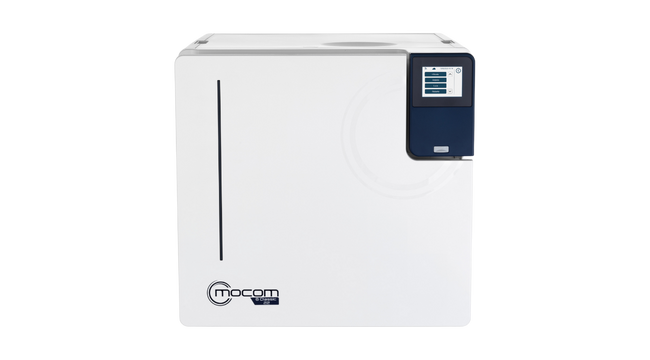
B Classic
With B Classic, practitioners can count on excellent sterilization, cycle after cycle, ensuring unmatched long-term reliability.
-1.png)
Tethys
Available in three compact versions that easily fit underneath worktops, Tethys thermal disinfectors can be incorporated into any sterilization room layout, offering excellent flexibility.
-1.png)
Tethys H10 Plus
Tethys H10 Plus transforms the instrument reconditioning process into a fast, simple, safe workflow.
.png)
Tethys HMD
The HMD accessory allows up to 6 instruments to be washed, disinfected and dried simultaneously in a single 34-minute cycle.
.png)
Thalya
In just a few seconds, Thalya lubricates and purges up to 4 instruments simultaneously, shortening treatment times and increasing safety.
.png)
Thalya Plus
Rotary instruments are valuable allies in any dental practice but without proper maintenance they can become a source of cross-contamination.
.png)
Millseal+ EVO
With its compact, linear design, our thermal sealer is easy to use and features automatic control of the preparation phase.
-1.png)
Millseal+ Manual
Ergonomics, practicality and compact design. Our thermal sealers feature visual/acoustic indicators that allow real-time monitoring of operation while electronic parameter control ensures a 12 mm sealing band, exceeding the standards required by law.
.png)
Millseal Rolling
Fast and flawless: the roller-type Millseal Rolling dental thermal sealer features an automatic photocell-activated feed system, offering performance that exceeds expectations.
-1.png)
V10
The V10 unit by Mocom is the first column-mounted treatment centre in the range. Designed for pure simplicity and practicality, V10 streamlines every dental team’s workflow.
.png)
M10
The M10 dental unit by Mocom is built to support professionals with an advanced, upgradeable platform.
-1.png)
F10
The F10 system by Mocom is an advanced and flexible solution designed to meet the essential needs of dental professionals.